new

Get trending papers in your email inbox!

Subscribe

Trending Papers

byAK and the research community

Trending Papers
Submitted by
taesiri

Kimi K3: Open Frontier Intelligence

We introduce Kimi K3, a 2.8T parameter Mixture-of-Experts model with 104 billion activated parameters, native vision capabilities, and a 1-million-token context window. Kimi K3 is built on Kimi Delta Attention and Attention Residuals, which improve information flow across sequence length and model depth. Together with Stable LatentMoE, which effectively activates 16 of 896 routed experts per token, and refined training and data recipes, these advances yield an approximately 2.5x improvement in overall scaling efficiency over Kimi K2. Post-training highlights reinforcement learning across general, agentic, and coding domains and multiple reasoning-effort levels, enabling compositional generalization and robust long-horizon execution. At 2.8T scale, Kimi K3 is supported by infrastructure advances in multiple areas: algorithm-system co-design for KDA, perfectly balanced expert-parallel training with efficient memory management, million-token agentic RL with persistent rollout and sandbox states, and deployment innovations. Extensive evaluations show that Kimi K3 achieves frontier-level performance across long-horizon coding, agentic, knowledge, reasoning, and vision tasks. While its overall performance still trails the most powerful proprietary models, namely Claude Fable 5 and GPT-5.6 Sol, Kimi K3 consistently outperforms other open and proprietary models evaluated in our suite. We release the full Kimi K3 model weights to facilitate future research and accelerate the broader deployment and adoption of frontier intelligence.

moonshotai Moonshot AI · Jul 27, 2026
Submitted by
taesiri

Unlimited OCR Works

Unlimited OCR introduces Reference Sliding Window Attention to eliminate growing memory consumption during long-sequence OCR tasks, enabling efficient transcription of multiple pages in a single forward pass.

baidu BAIDU · Jun 22, 2026

Kronos: A Foundation Model for the Language of Financial Markets

Kronos, a specialized pre-training framework for financial K-line data, outperforms existing models in forecasting and synthetic data generation through a unique tokenizer and autoregressive pre-training on a large dataset.

  • 7 authors
· Aug 2, 2025
Submitted by
unilm

VibeVoice Technical Report

VibeVoice synthesizes long-form multi-speaker speech using next-token diffusion and a highly efficient continuous speech tokenizer, achieving superior performance and fidelity.

MicrosoftResearch Microsoft Research · Aug 26, 2025
Submitted by
taesiri

LongCat-Video Technical Report

LongCat-Video, a 13.6B parameter video generation model based on the Diffusion Transformer framework, excels in efficient and high-quality long video generation across multiple tasks using unified architecture, coarse-to-fine generation, and block sparse attention.

meituan-longcat LongCat · Oct 25, 2025

Native and Compact Structured Latents for 3D Generation

A new sparse voxel representation called O-Voxel enables high-quality 3D generative modeling with efficient inference and robust topology handling.

microsoft Microsoft · Dec 16, 2025
Submitted by
Senqiao

Mage-VL: An Efficient Codec-Native Streaming Multimodal Foundation Model

Standard vision-language models (VLMs) suffer from Moravec's paradox: they excel at complex offline visual reasoning but struggle with simple streaming perception tasks and process them inefficiently. We present Mage-VL, an efficient codec-native streaming foundation model for real-time multimodal understanding and interaction. At its core, our custom tokenizer, Mage-ViT, replaces uniform frame sampling by selectively encoding dynamic, entropy-rich regions using motion vectors and residual energy across sparse anchor (I) and predicted (P) frames. Operating at a 16 x 16 patch level, this reduces visual token consumption by over 75% while preserving spatiotemporal context. Trained from scratch on approximately 560M unlabeled images and 100M unlabeled video frames, Mage-ViT matches or outperforms flagship encoders trained on billions of image-text pairs. We establish AI4AI data pipelines encompassing prompt-code joint optimization for multimodal captioning and AI-driven performance diagnosis to guide training recipes. Furthermore, through a bio-inspired dual-system architecture - a lightweight System 1 event gate and a causal System 2 decoder - Mage-VL enables proactive streaming perception. Extensive evaluations show that Mage-VL-4B matches Qwen3-VL-4B on static tasks while achieving strong gains in video understanding and 2D/3D spatial reasoning, with up to a 3.5x wall-clock inference speedup, and comprehensively surpasses the 15B Phi-4-reasoning-vision baseline. Beyond model artifacts, we deliver seven key empirical findings covering pre-training data efficiency, variable-resolution scaling, codec system acceleration, VideoQA SFT redundancy, motion-spatial synergy, AI4AI data pipelines, and Zero-Vision SFT for multimodal RL.

microsoft Microsoft · Jul 27, 2026
Submitted by
iseesaw

Frontis-MA1: Training an AI4AI Model towards Recursive Self-Improvement in Machine Learning Engineering

Recursive self-improvement (RSI) requires AI systems that improve the process of building AI (i.e., AI4AI); machine learning engineering (MLE) offers a concrete, executable testbed for studying this capability. We introduce OpenMLE, an open full-stack system for RSI research in MLE, spanning verifiable task environments with execution feedback (OpenMLE-Gym), operator learning (OpenMLE-RL), and long-horizon search (OpenMLE-Evo). On this stack we post-train Frontis-MA1 (35B) as a meta-evolution agent for MLE, aligning post-training and inference around four atomic program-evolution operators (Draft, Improve, Debug, Crossover): the same operators are trained via execution-grounded SFT and RL on data deduplicated against all evaluation benchmarks, then composed into long-horizon search, coupling learning and evolution in a single loop. On MLE-Bench Lite under a 12-hour per-task budget on one RTX 4090 capped at 12 GB VRAM, Frontis-MA1 (35B) improves Medal Average from 39.39% to 60.61% over its base model with OpenMLE-Evo, and reaches 71.21% with OpenMLE-Evo-Max (benchmark-independent experience priors and asynchronous search), exceeding GPT-5.5 + Codex and approaching GPT-5.6 Sol and the 2.8T Kimi K3. On held-out NatureBench Lite, both components transfer: with the framework fixed, swapping in the trained model raises Match-SOTA from 50% to 70%; with the model fixed, swapping in OpenMLE-Evo raises it from 20% to 50%. We release the model weights and the full OpenMLE stack to enable reproducible research on executable AI4AI toward RSI. Code: https://github.com/FrontisAI/OpenRSI

FrontisAI Frontis AI · Jul 30, 2026
Submitted by
taesiri

MinerU2.5: A Decoupled Vision-Language Model for Efficient High-Resolution Document Parsing

MinerU2.5, a 1.2B-parameter document parsing vision-language model, achieves state-of-the-art recognition accuracy with computational efficiency through a coarse-to-fine parsing strategy.

  • 61 authors
· Sep 26, 2025

TradingAgents: Multi-Agents LLM Financial Trading Framework

A multi-agent framework using large language models for stock trading simulates real-world trading firms, improving performance metrics like cumulative returns and Sharpe ratio.

  • 4 authors
· Dec 28, 2024
Submitted by
nielsr

Geometric Context Transformer for Streaming 3D Reconstruction

LingBot-Map is a feed-forward 3D foundation model that reconstructs scenes from video streams using a geometric context transformer architecture with specialized attention mechanisms for coordinate grounding, dense geometric cues, and long-range drift correction, achieving stable real-time performance at 20 FPS.

robbyant Robbyant · Apr 15, 2026
Submitted by
akhaliq

OpenDevin: An Open Platform for AI Software Developers as Generalist Agents

OpenDevin is a platform for developing AI agents that interact with the world by writing code, using command lines, and browsing the web, with support for multiple agents and evaluation benchmarks.

  • 24 authors

· Jul 23, 2024
Submitted by
Lin-Chen

VideoCoCo: Code-as-CoT for Physically-Consistent Video Generation via an Agentic Dual-Engine System

Text-to-video models have achieved remarkable visual quality, yet they still struggle to generate physically consistent dynamics because the temporal evolution of a scene must be inferred implicitly from a highly compressed text prompt. Existing chain-of-thought approaches introduce intermediate plans or visual states, but these representations are typically non-executable or temporally sparse, limiting their ability to instantiate and control the complete spatiotemporal process. To address this limitation, we introduce VideoCoCo, an agentic dual-engine framework in which executable Blender code serves as a process-level chain of thought. Given a text prompt, a coding agent synthesizes a Blender program that explicitly specifies the scene and its temporal evolution. The executable simulation engine runs the program to produce a deterministic spatiotemporal draft, which is subsequently transformed into a photorealistic video by a generative video engine through draft-conditioned editing. This decomposition separates process-level reasoning from high-fidelity visual realization. To adapt the video editor to simulated drafts, we construct VideoCoCo-3K, a curated dataset of draft-instruction-target triplets. VideoCoCo improves the OmniWeaving baseline from 0.475 to 0.558 on PhyGenBench and from 52.18 to 77.88 on VBench-2.0, achieving the best average score on both benchmarks. These results demonstrate that executable code provides an effective, controllable, and inspectable intermediate representation for physically consistent video generation.

  • 28 authors
· Jul 29, 2026
Submitted by
dkliang

TurboVLA: Real-Time Vision-Language-Action Model at 32 Hz on an RTX 4090 with <1 GB VRAM

Vision-language-action (VLA) models commonly adopt an LLM-centric V to L to A pathway, where visual observations are projected into the representation space of a large language model before being decoded into robot actions. Although effective, this design incurs substantial computation and memory overhead at every policy invocation. In this work, we introduce TurboVLA, a new VLA paradigm that reformulates the conventional V to L to A pathway as a direct V + L to A mapping. Instead of using a large language model as the central interface between perception and action, TurboVLA independently encodes visual observations and language instructions, directly exchanges information between them through lightweight bidirectional vision-language interaction, and predicts continuous action chunks with a compact decoder. This simple design constructs task-conditioned representations directly from visual and linguistic features, significantly reducing the computational and memory costs of VLA inference. On LIBERO, TurboVLA achieves 97.7% average success with only 0.2B parameters, 31.2 ms inference latency, and 0.9 GB inference VRAM on a consumer-grade RTX 4090, matching or outperforming substantially larger VLA policies. These results establish TurboVLA as a simple and effective alternative to the prevailing LLM-centric VLA paradigm, offering a new perspective on how vision, language, and action can be connected for efficient robotic manipulation. Code is available at https://github.com/H-EmbodVis/TurboVLA.

H-EmbodVis H-EmbodVis · Jul 29, 2026
Submitted by
taesiri

Fish Audio S2 Technical Report

Fish Audio S2 is an open-source text-to-speech system with multi-speaker capabilities, multi-turn generation, and instruction-following control through natural-language descriptions, utilizing a multi-stage training approach and production-ready inference engine.

fishaudio Fish Audio · Mar 9, 2026
Submitted by
akhaliq

Mem0: Building Production-Ready AI Agents with Scalable Long-Term Memory

Mem0, a memory-centric architecture with graph-based memory, enhances long-term conversational coherence in LLMs by efficiently extracting, consolidating, and retrieving information, outperforming existing memory systems in terms of accuracy and computational efficiency.

  • 5 authors
· Apr 28, 2025
Submitted by
taesiri

SkillOpt: Executive Strategy for Self-Evolving Agent Skills

SkillOpt introduces a systematic text-space optimizer for agent skills that trains skills as external agent state with stable updates and zero deployment inference overhead, achieving superior performance across multiple benchmarks and execution environments.

MicrosoftResearch Microsoft Research · May 22, 2026
Submitted by
akhaliq

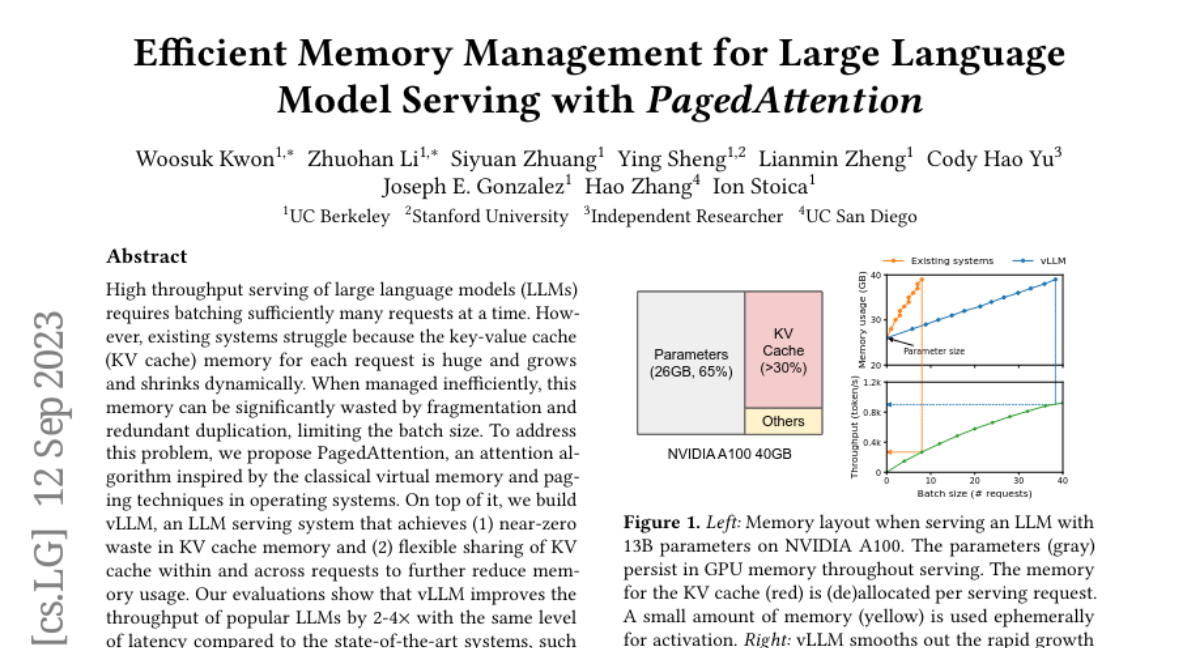
Efficient Memory Management for Large Language Model Serving with PagedAttention

PagedAttention algorithm and vLLM system enhance the throughput of large language models by efficiently managing memory and reducing waste in the key-value cache.

  • 9 authors
· Sep 12, 2023
Submitted by
ChengCui

PaddleOCR-VL-1.6: Expanding the Frontier of Document Parsing with Under-Optimized Region Refinement and Progressive Post-Training

PaddleOCR-VL-1.6 enhances document parsing performance through targeted data optimization and progressive post-training techniques, achieving state-of-the-art results on OmniDocBench v1.6.

PaddlePaddle PaddlePaddle · Jun 2, 2026
Submitted by
Liang0223

On the Generalization of SFT: A Reinforcement Learning Perspective with Reward Rectification

Dynamic Fine-Tuning (DFT) improves the generalization of Large Language Models (LLMs) by dynamically rescaling gradients, outperforming standard Supervised Fine-Tuning (SFT) and showing competitive results in offline reinforcement learning.

  • 10 authors

· Aug 7, 2025
Submitted by
LYL1015

JarvisHub: An Open Harness for Canvas-Native Multimodal Creative Agents

Creative AI is moving from single-step asset generation toward long-horizon multimodal production. Although recent generative models can synthesize high-quality images, videos, audio clips, UI elements, storyboards, slides, and other creative assets, real-world creative work requires more than isolated prompt-output interactions. It involves references, drafts, alternatives, edits, failed attempts, version relations, tool actions, evaluation signals, and human feedback, which together form an evolving project state. Existing prompt-based, chat-based, and node-based generation systems only partially support this state, as they often discard intermediate context, rely on linear conversations, or require manually specified workflows. Recent commercial systems indicate a shift toward agent-assisted creative production, but their closed architectures make it difficult to study how agents represent context, choose tools, revise artifacts, recover from failures, and maintain consistency over time. To address this gap, we introduce JarvisHub, a canvas-native creative agent harness for long-horizon multimodal creation. JarvisHub treats an editable canvas as the user workspace, the agent's external memory, action space, and shared project state, representing multimodal artifacts, dependencies, versions, and feedback as typed canvas nodes and links. Through a three-layer architecture of canvas state, protocol bridge, and agent runtime, JarvisHub enables agents to act within an inspectable and editable creative state. This design moves creative agents beyond isolated tool use toward sustained, human-steerable creative automation, where agents can progressively plan, generate, revise, and organize multimodal projects while users remain able to inspect, guide, and intervene throughout the process.

  • 26 authors
· Jul 26, 2026
Submitted by
andito

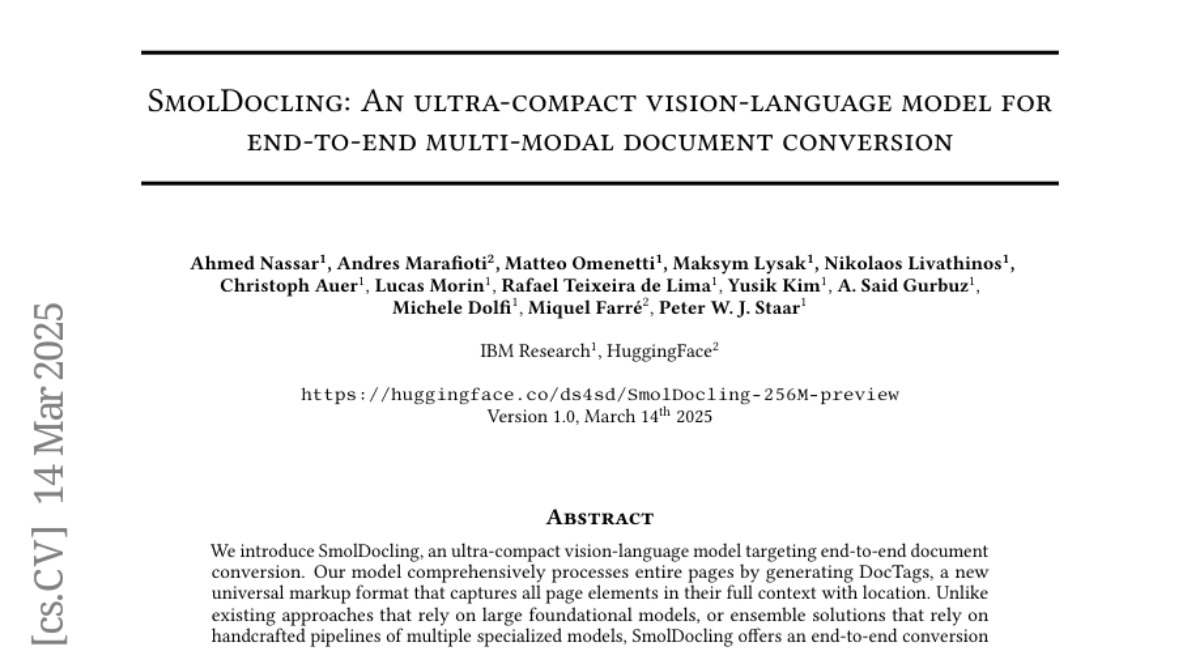
SmolDocling: An ultra-compact vision-language model for end-to-end multi-modal document conversion

SmolDocling is a compact vision-language model that performs end-to-end document conversion with robust performance across various document types using 256M parameters and a new markup format.

ibm-granite IBM Granite · Mar 14, 2025
Submitted by
ldkong

Data Pyramid for Embodied Manipulation

Multimodal foundation models learned to see and to speak by consuming the whole internet. Embodied agents admit no such shortcut, since they require data that couple observations with physical states and actions. These signals can be provided, to varying degrees, by multiple data sources. In this work, we organize the embodied data ecosystem as a "pyramid" spanning five complementary sources: real-robot data, UMI-style data, egocentric and exocentric data, simulation data, and general vision-language data. We organize the pyramid around the tension between scalability and robot alignment, and further characterize each source in terms of data quality, diversity, reusability, and physical fidelity. We then analyze recent embodied foundation models through the lens of their data recipes, examining how different sources are selected, aligned, and mixed during pretraining. For embodied brain models, vision-language-action models, and world-action models alike, we relate data composition to capabilities in perception, reasoning, planning, action generation, and world prediction. We close by discussing six open challenges: building large-scale tactile datasets, collecting failure and recovery data, developing scalable data-collection pipelines, aligning actions across embodiments, leveraging egocentric data for dexterous manipulation, and designing principled data recipes for robot learning. We hope this work paves the foundation for the design of next-generation embodied systems.

PekingUniversity Peking University · Jul 27, 2026
Submitted by
RuofengYang

ARIS: Autonomous Research via Adversarial Multi-Agent Collaboration

ARIS is an open-source research harness that uses cross-model adversarial collaboration to ensure reliable long-term research outcomes through coordinated execution, orchestration, and assurance layers.

LightRAG: Simple and Fast Retrieval-Augmented Generation

LightRAG improves Retrieval-Augmented Generation by integrating graph structures for enhanced contextual awareness and efficient information retrieval, achieving better accuracy and response times.

  • 5 authors
· Oct 8, 2024

HuggingFace's Transformers: State-of-the-art Natural Language Processing

Transformers library provides state-of-the-art Transformer architectures and pretrained models for natural language processing tasks with a unified API and emphasis on extensibility and robust deployment.

huggingface Hugging Face · Oct 9, 2019
Submitted by
yh-wang

Orca: The World is in Your Mind

Orca establishes a unified world latent space through next-state-prediction modeling using multimodal data and demonstrates superior performance in downstream tasks compared to specialized baselines.

  • 57 authors
· Jun 29, 2026
Submitted by
taesiri

Molt: A Scalable PyTorch-Native Training Framework for Agentic Reinforcement Learning

Agentic reinforcement learning research is constant algorithm modification, new estimators, new pipeline stages, new rollout schemes, and in mainstream frameworks each change threads through layers of trainer, distributed backend, and rollout glue: the cost lands on the researcher at every iteration. Molt is a PyTorch-native training framework built to keep that cost small: a codebase compact and clean enough for a researcher to hold in their head, and for an AI coding assistant to read and reason about in its entirety, so the algorithm flow can be traced and changed end to end. The agent is an ordinary program, and one asynchronous loop trains multimodal and mixture-of-experts policies while never training on a token it did not generate, consistent in tokens, policy versions, and model semantics. Leanness does not cost performance: under a matched, fully asynchronous protocol, Molt is statistically comparable to a state-of-the-art Megatron-based stack. Molt is open source and provides recipes and containers at https://github.com/NVIDIA-NeMo/labs-molt.

nvidia NVIDIA · Jul 22, 2026

Zep: A Temporal Knowledge Graph Architecture for Agent Memory

Zep, a memory layer service, outperforms MemGPT in the DMR benchmark and LongMemEval by excelling in dynamic knowledge integration and temporal reasoning, critical for enterprise use cases.

  • 5 authors
· Jan 20, 2025

OmniFlatten: An End-to-end GPT Model for Seamless Voice Conversation

A novel GPT-based model, OmniFlatten, enables real-time natural full-duplex spoken dialogue through a multi-stage post-training technique that integrates speech and text without altering the original model's architecture.

  • 9 authors
· Oct 23, 2024
Submitted by
nielsr

Ultralytics YOLO26: Unified Real-Time End-to-End Vision Models

YOLO26 addresses real-time vision challenges through a unified model family with NMS-free inference, improved training strategies, and multi-task capabilities spanning detection, segmentation, and pose estimation.

Ultralytics Ultralytics · Jun 2, 2026

EverMemOS: A Self-Organizing Memory Operating System for Structured Long-Horizon Reasoning

EverMemOS presents a self-organizing memory system for large language models that processes dialogue streams into structured memory cells and scenes to enhance long-term interaction capabilities.

  • 11 authors
· Jan 5, 2026
Submitted by
akhaliq

Very Large-Scale Multi-Agent Simulation in AgentScope

Enhancements to the AgentScope platform improve scalability, efficiency, and ease of use for large-scale multi-agent simulations through distributed mechanisms, flexible environments, and user-friendly tools.

  • 8 authors
· Jul 25, 2024
Submitted by
taesiri

AgentScope 1.0: A Developer-Centric Framework for Building Agentic Applications

AgentScope enhances agentic applications by providing flexible tool-based interactions, unified interfaces, and advanced infrastructure based on the ReAct paradigm, supporting efficient and safe development and deployment.

  • 23 authors
· Aug 22, 2025

AutoDev: Automated AI-Driven Development

AutoDev is an AI-driven software development framework that automates complex engineering tasks within a secure Docker environment, achieving high performance in code and test generation.

  • 5 authors
· Mar 13, 2024
Submitted by
fistyyyy

ResearchStudio-Idea: An Evidence-Grounded Research-Ideation Skill Suite from ML Conference Outcomes

ResearchStudio-Idea provides a skill suite for effective research ideation that combines literature search, novelty checking, and pattern-guided generation to produce traceable research proposals.

microsoft Microsoft · Jul 5, 2026
Submitted by
LiJiaxing

DistillAlign: Coordinating Mode Covering and Mode Seeking in Autoregressive Video Distillation

Existing autoregressive video distillation methods commonly adopt a Distribution Matching Distillation (DMD)-based multi-stage pipeline. However, they typically decouple the initialization and DMD stages -- which then pursue different target distributions -- and judge the intermediate student mainly by visual scores such as VBench. In this paper, we revisit this design from a distributional perspective. Given the mode-seeking nature of the distribution matching loss, a good initialization should match the mode coverage of the target DMD teacher, rather than merely pursuing high quality. To analyze this, we introduce a distributional evaluation protocol that measures precision and coverage between student and teacher distributions in a shared latent space. It exposes differences hidden by visual scores: some initializations reach high precision but low coverage, leading to suboptimal refinement, while mode-covering ones preserve broader support. Furthermore, even when the target distributions are aligned, DMD's reverse-KL objective can still drive the student toward high-probability teacher regions in late training, reducing coverage and diversity. To address this, we propose joint distillation, which combines DMD's mode-seeking objective with a Consistency Distillation-based mode-covering constraint. Experiments show that our method improves generation quality, coverage, and diversity; notably, even with a Wan-1.3B DMD teacher, it outperforms baselines refined with Wan-14B, underscoring the importance of distributional alignment in autoregressive video distillation.

  • 10 authors
· Jul 29, 2026
Submitted by
zbhpku

DataFlow: An LLM-Driven Framework for Unified Data Preparation and Workflow Automation in the Era of Data-Centric AI

DataFlow is an LLM-driven data preparation framework that enhances data quality and reproducibility for various tasks, improving LLM performance with automatically generated pipelines.

PekingUniversity Peking University · Dec 18, 2025
Submitted by
Jeff-Wang

GigaWorld-1: A Roadmap to Build World Models for Robot Policy Evaluation

World models for robotic policy evaluation are systematically studied through a new benchmark, revealing that long-horizon rollout consistency and robot-specific controllability are more important than short-term visual realism for reliable policy assessment.

open-gigaai GigaAI · Jul 2, 2026

Moonshine: Speech Recognition for Live Transcription and Voice Commands

Moonshine, an encoder-decoder transformer architecture for speech recognition, uses Rotary Position Embedding, reducing compute requirements without decreasing accuracy.

  • 6 authors
· Oct 21, 2024
Submitted by
evanking

Flavors of Moonshine: Tiny Specialized ASR Models for Edge Devices

Monolingual ASR models trained on a balanced mix of high-quality, pseudo-labeled, and synthetic data outperform multilingual models for small model sizes, achieving superior error rates and enabling on-device ASR for underrepresented languages.

  • 5 authors
· Sep 2, 2025

IndexTTS: An Industrial-Level Controllable and Efficient Zero-Shot Text-To-Speech System

IndexTTS, an enhanced text-to-speech system combining XTTS and Tortoise models, offers improved naturalness, enhanced voice cloning, and controllable usage through hybrid character-pinyin modeling and optimized vector quantization.

  • 5 authors
· Feb 8, 2025
Submitted by
DavidSunok

INTACT: Isomorphic Intent-to-Action Learning for Search-Free World Models

Forward latent world models predict how actions change a scene, but recover actions for a desired change only through expensive test-time search. We introduce INTACT (INtent-To-ACTion), an end-to-end JEPA that turns action-labeled, reward-free trajectories into a deployable intent-to-action interface. Each transition supplies physical intent z_{t+1}-z_t, while a future goal supplies deployment intent sg(z_g)-z_t. The architecture is isomorphic between the local and goal motion-intent backbone-input graphs through an identical four-slot grammar and shared parameters, and between supported local and goal motion-intent families through action-law semantics induced by the same predictor rather than pointwise latent equality. INTACT also provides intact transfer from RGB evidence to action-effective latent intent coordinates and from intent families to their corresponding action-law families. Asymmetric endpoint gradients ground physical successors and fix future goals as anchors, joining representation learning and control without pointwise latent matching or globally linear dynamics. The resulting coordinates support a robust distributional action law: its conditional mean serves directly as a search-free policy, while sampling remains available for diversity or optional verification. On the four official LeWM tasks, one-epoch, zero-search models reach 85.78\%, 100.00\%, 97.67\%, and 97.89\% success. Optional local CEM centered on the Direct plan reaches 96.86\% macro success using 384 instead of 9,000 candidate sequences, reducing sampling by 23.44times while improving pure CEM by 16.00 points. One shared four-task encoder reaches 89.39\% E5 Direct macro and improves every task over jointly trained LeWM, while predicted--expert action-family kNN tracks Direct success at r=0.954. Direct inference takes 2.9--5.5 ms.

zju Zhejiang University · Jul 28, 2026
Submitted by
UglyToilet

MemOS: A Memory OS for AI System

MemOS, a memory operating system for Large Language Models, addresses memory management challenges by unifying plaintext, activation-based, and parameter-level memories, enabling efficient storage, retrieval, and continual learning.

  • 39 authors
· Jul 4, 2025

Efficient Guided Generation for Large Language Models

An efficient method guides language model text generation using regular expressions and context-free grammars with minimal overhead.

  • 2 authors
· Jul 19, 2023
Submitted by
andito

SmolVLA: A Vision-Language-Action Model for Affordable and Efficient Robotics

SmolVLA is a compact, efficient vision-language-action model that achieves competitive performance at reduced computational costs and can be deployed on consumer-grade hardware.

  • 14 authors

· Jun 2, 2025
Submitted by
taesiri

PhiZero: A World Model Built Around Physical Language

We introduce PhiZero, a physical world model built around physical language, a compact discrete representation of world-state transitions. Existing physical world models typically predict future videos directly in pixel space, leaving the underlying world dynamics implicit within high-dimensional visual predictors. Motivated by humans' ability to abstract predictive structure from visual experience and organize it in natural language for explicit reasoning, we learn physical language from in-the-wild videos through self-supervision and use it to explicitly reason about how the physical world evolves. Accordingly, PhiZero adopts a reason-then-render paradigm: it first infers future world evolution as a physical-language sequence and then renders the inferred transitions into videos. Extensive experiments across generation and understanding benchmarks validate the ability of PhiZero to model physically coherent world evolution. We further show its potential for realistic and interactive world modeling, fine-grained action-conditioned simulation, and zero-shot motion transfer.

  • 7 authors

· Jul 30, 2026
Submitted by
nielsr

MonkeyOCRv2: A Visual-Text Foundation Model for Document AI

Mainstream visual encoders are pretrained on natural images and cannot be effectively applied to document images without document-oriented adaptation, as dense text and fine-grained character strokes demand character-level visual perception. We present MonkeyOCRv2, a visual-text pretrained model for document AI. First, we construct MonkeyDoc v2, to our knowledge the largest document-image pretraining corpus, comprising 113 million images spanning 17 languages. Second, we propose a pretraining strategy that jointly learns image-to-text generation and pixel-level document reconstruction: the former aligns visual representations with textual content, while the latter preserves character strokes and layout details. Extensive experiments are conducted on five representative document analysis tasks, including text recognition, formula recognition, text detection, document tampering detection, and overlapping text segmentation. Replacing the original encoders with MonkeyOCRv2 consistently improves performance across all five tasks. Finally, we validate its effectiveness as the vision encoder of multimodal large language models on the more challenging tasks of document parsing and document understanding. Kept frozen and paired with a lightweight language model, it yields a 0.7B document parsing model that sets a new open-source state-of-the-art on MDPBench, a recent benchmark spanning digital-born and photographed documents across 17 languages, surpassing the previous best 3B dots.mocr by 2.8% absolute with a vision encoder roughly 11times smaller. The frozen encoder also powers a document understanding model that outperforms counterparts built on CLIP, DINO, and SAM across eight benchmarks under identical training settings. These results suggest that document-oriented visual pretraining can serve as a foundation for document intelligence in its own right.

VLRLab-OCR VLRLab-OCR · Jul 13, 2026
Submitted by
lhpku20010120

K12-KGraph: A Curriculum-Aligned Knowledge Graph for Benchmarking and Training Educational LLMs

Large language models are increasingly used in K-12 education, but existing benchmarks mainly test exam question answering rather than understanding how curriculum knowledge is structured and visually presented. We call this capability curriculum cognition. It covers prerequisite chains, concept taxonomies, experiment-concept links, pedagogical sequencing, and visual grounding. We introduce K12-KGraph, a curriculum-aligned knowledge graph extracted from official People's Education Press textbooks in mathematics, physics, chemistry, and biology across primary, middle, and high school. It contains nine node types and fourteen relation types covering curriculum structure and visual grounding. From this graph, we derive K12-Bench, a 23,640-question multi-select benchmark with five task families: Ground, Prereq, Neighbor, Evidence, and Locate. We also build K12-Train, a graph-guided supervised fine-tuning corpus of 7,335 samples, including 2,267 text-only QA pairs and 5,068 multimodal VQA pairs. On K12-Bench, Gemini-3-Flash achieves only 57 percent exact match and Gemma-4-31B-IT reaches 46 percent, with Prereq and Neighbor being the hardest tasks. Our training experiments show that domain-specific supervision can reduce this gap. Under a matched 2,300-sample budget, K12-Train-Text consistently outperforms equally sized subsets of eight mainstream instruction-tuning corpora on GaokaoBench and EduEval. For vision-language models, K12-Train-Full achieves the best overall results on Gaokao-MM, MDK12-medium, and K12Vista among all compared training configurations, despite using fewer samples than the full DataFlow and WizardLM baselines. It also surpasses both text-only and multimodal-only variants, showing that textual and visual supervision are complementary. We release the graph, benchmark, training data, and complete construction pipeline.

PekingUniversity Peking University · Jul 23, 2026
Submitted by
YeolJoo

ReDesign: Recovering Editable Design Structures from Images via Agentic Decomposition

Recovering an editable design file from a raster image is a common and costly bottleneck in modern design workflows, yet remains challenging since editability depends on recovering multi-modal attributes, such as typography, vector geometry, colors, grouping, and layer ordering. We present ReDesign, an agentic framework that grows an editable layer hierarchy by selecting and composing specialized tools across modalities. To keep this long decision process reliable despite imperfect tool outputs, we introduce graceful verification at each expansion, which provides local accept, prune, or retry feedback that prevents error accumulation and avoids large scale reruns. To evaluate editability at scale, we introduce the Figma Edit Replay Benchmark, consisting of 909 raw Figma files and 14,796 controlled edit instructions that replay edits on reconstructed outputs. Across this benchmark and standard reconstruction metrics, ReDesign achieves strong visual fidelity while delivering the highest editability across layout, color, and text edits, outperforming layered decomposition baselines and serial tool use pipelines.

kaist-ai KAIST AI · Jul 28, 2026