


chen-si-02/AnyHand-Models
Updated • 2
NeurIPS 2026 · Evaluations and Datasets Track




6,337,536 released RGB-D samples · 47,438 hand shapes · 10,240 hand textures · 500K+ objects
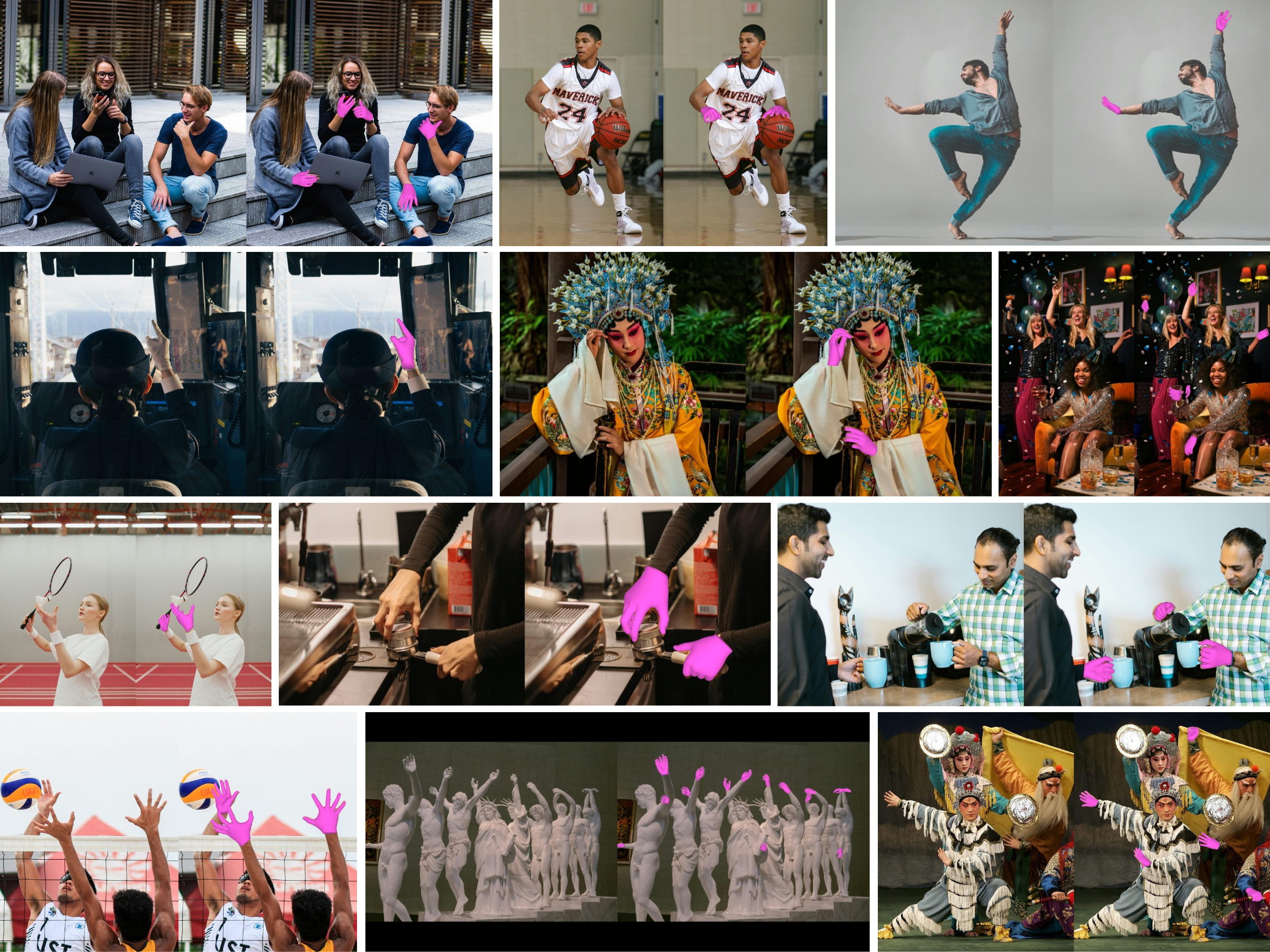
Official dataset release. Both train and test splits are available in this Hugging Face repository. The current release contains 6,189 standard TAR shards / 6,337,536 RGB-D samples, including 32 test shards / 32,768 test samples. The approximately 6.6M-image figure reported in the paper describes the research-scale dataset; the exact available inventory is listed below. Counts were verified against the published train/test manifests and HF file size/SHA-256 metadata on October 14, 2026.
Access: This public dataset uses automatic access approval. Sign in to Hugging Face, accept the dataset conditions, and authenticate before downloading. The original TAR format is retained and the built-in dataset viewer is disabled.
AnyHand is a large-scale synthetic dataset for 3D hand pose and mesh reconstruction, supporting both RGB-only and RGB-D learning. It brings together diverse hand articulations, realistic skin and forearm appearance, varied cameras and illumination, hand-object occlusion, and paired geometric supervision at a scale difficult to obtain from real capture.
The paper describes two complementary branches. The following table gives the scale reported in the paper; use the published train/test inventory below for the exact available samples:
| Branch | Description | Images | Rendered scenes |
|---|---|---|---|
| AnyHand-Single | Isolated hands with attached forearms, broad pose/shape/appearance and viewpoint diversity | 2.5M | 1.25M |
| AnyHand-Interact | Hands manipulating objects, including natural grasps and object-induced occlusion | 4.1M | 2.05M |
| Total | Aligned RGB-D and rich geometric annotations | 6.6M | 3.30M |
Each scene is rendered from two camera viewpoints. The dataset is designed to complement real-world training datasets, not necessarily to replace them: the paper shows that combining synthetic and real data improves hand reconstruction and generalization.
| Split | Repository directory | TAR shards | Samples |
|---|---|---|---|
| Train | data/train/single/ |
2,440 | 2,498,560 |
| Train | data/train/interact-env/ |
1,630 | 1,669,120 |
| Train | data/train/interact-indoor/ |
2,087 | 2,137,088 |
| Train subtotal | 6,157 | 6,304,768 | |
| Test | data/test/single-env/ |
8 | 8,192 |
| Test | data/test/single-indoor/ |
8 | 8,192 |
| Test | data/test/interact-env/ |
8 | 8,192 |
| Test | data/test/interact-indoor/ |
8 | 8,192 |
| Test subtotal | 32 | 32,768 | |
| Total | 6,189 | 6,337,536 |
Each standard TAR contains 1,024 paired samples. All four test categories have eight TARs each, named 000000.tar through 000007.tar. The test split contains 16,384 single-hand and 16,384 hand-object interaction samples across environment and indoor scenes.
The synthetic test split supports evaluation and debugging within this distribution. Keep it separate from training and report its results separately from the real-image benchmark protocols in the paper, including FreiHAND, HO-3D, and HO-Cap.
Use the training manifest and test manifest as the source of truth for file selection and reproducible experiments.
| Diversity / supervision | Scale or detail |
|---|---|
| Hand shapes | 47,438 MANO shape configurations |
| Hand textures | 10,240 appearances generated using Handy |
| Forearm textures | 254 textures from SMPLitex |
| Background sources | 1,270 indoor images and HDR environment maps |
| Hand-object interactions | 500K+ objects represented in GraspXL / Objaverse |
| Ground truth and metadata | RGB, depth, foreground masks, bounding boxes, camera parameters, and 3D pose/shape annotations |
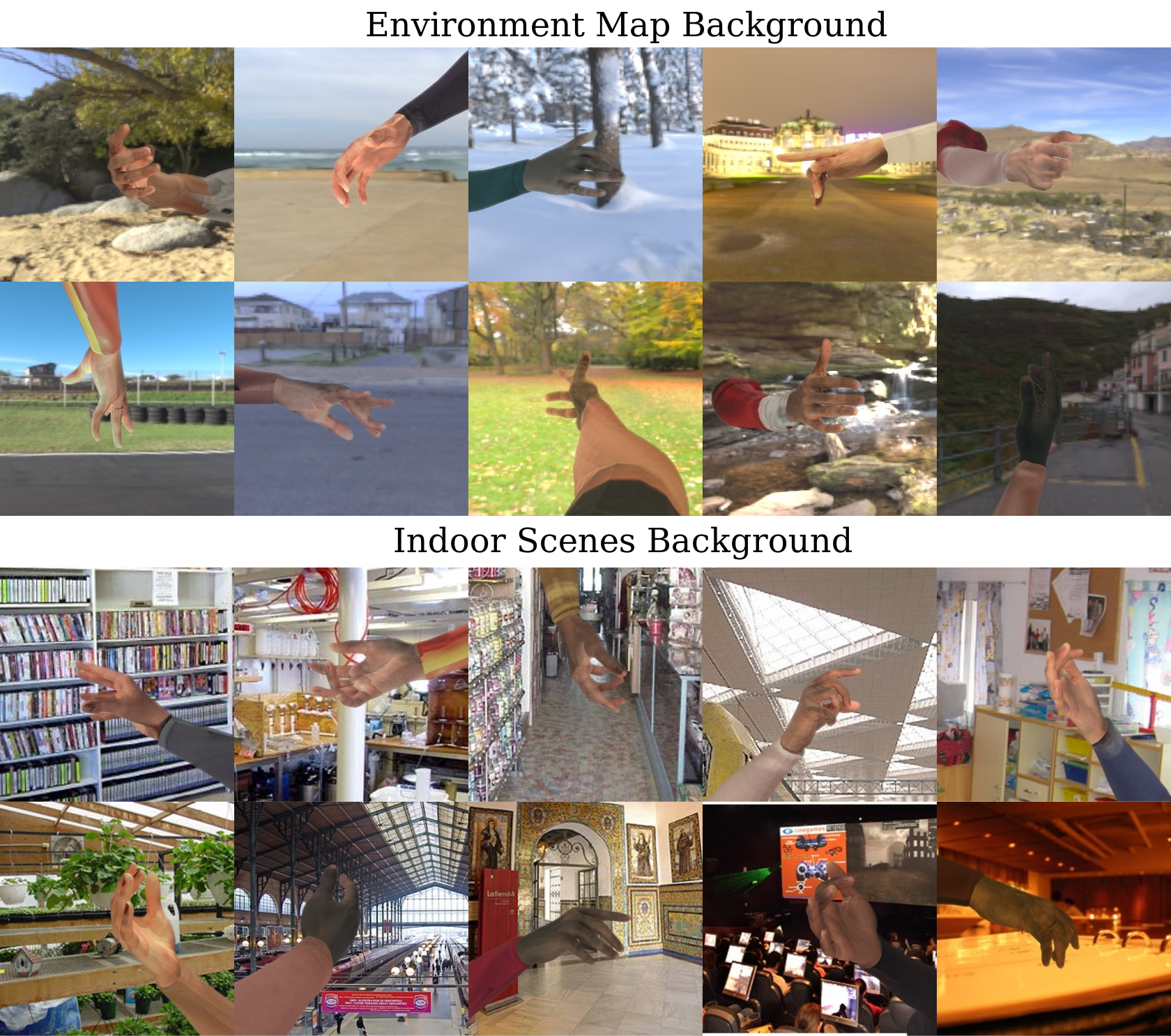
AnyHand-Single — diverse hands, textures, scenes, and viewpoints
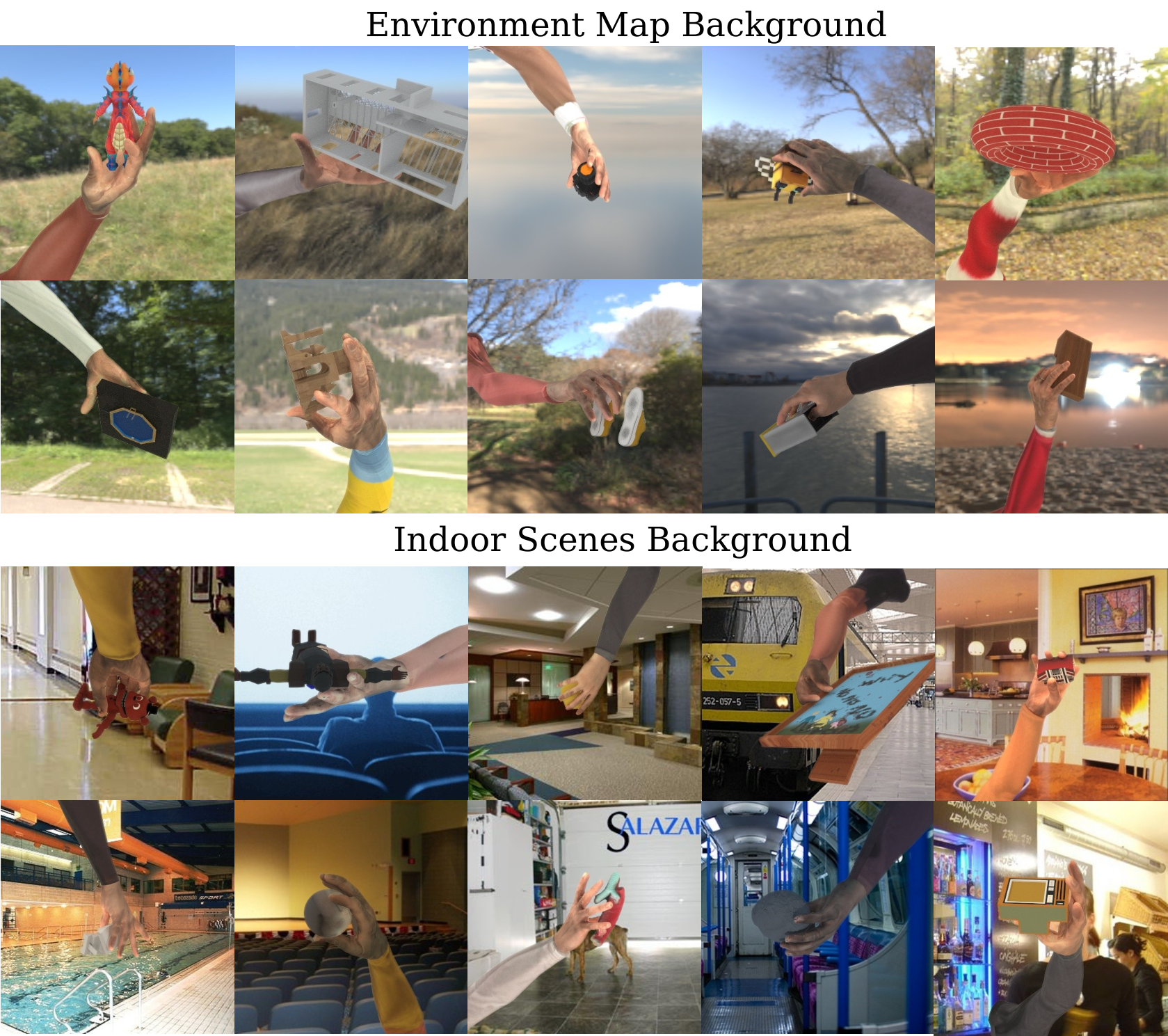
AnyHand-Interact — varied objects, grasps, and occlusions
More examples, the generation pipeline, and reconstruction comparisons are available on the project website.
The dataset is distributed directly from this Hugging Face repository in its original TAR-shard format. You do not need a reconstruction network or MANO assets just to download or inspect RGB/depth images.
Request access on the dataset page, accept the conditions, and authenticate on your download machine:
python -m pip install -U huggingface_hub
hf auth login
Then download both inventories:
hf download chen-si-02/AnyHand-Dataset \
  manifests/shards.jsonl manifests/test_shards.jsonl \
  --repo-type dataset \
  --local-dir ./AnyHand
The HF client uses your locally saved token for authenticated downloads.
Entire test split — 32 TARs, about 4.16 GB:
hf download chen-si-02/AnyHand-Dataset \
  --repo-type dataset \
  --include 'data/test/*/*.tar' \
  --local-dir ./AnyHand
One test shard:
hf download chen-si-02/AnyHand-Dataset \
  data/test/single-indoor/000000.tar \
  --repo-type dataset \
  --local-dir ./AnyHand
One training shard:
hf download chen-si-02/AnyHand-Dataset \
  data/train/single/000000.tar \
  --repo-type dataset \
  --local-dir ./AnyHand
Downloaded files preserve the repository-relative paths. For example, the test shard is saved at ./AnyHand/data/test/single-indoor/000000.tar. For training subsets, select exact paths from the manifest. The full train/test TAR inventory is approximately 768.3 GB.
Read an RGB/depth pair without deserializing the annotation payload:
from io import BytesIO
import tarfile
from pathlib import Path

from huggingface_hub import hf_hub_download
from PIL import Image

path = hf_hub_download(
    repo_id="chen-si-02/AnyHand-Dataset",
    repo_type="dataset",
    filename="data/test/single-indoor/000000.tar",
)

with tarfile.open(path, "r") as tar:
    rgb_member = next(
        m for m in tar.getmembers()
        if m.isfile()
        and m.name.lower().endswith((".jpg", ".jpeg", ".png"))
        and not m.name.endswith((".depth.png", ".mask.png"))
    )
    stem = rgb_member.name.rsplit(".", 1)[0]

    with tar.extractfile(rgb_member) as fp:
        rgb = Image.open(BytesIO(fp.read())).convert("RGB")
    with tar.extractfile(tar.getmember(stem + ".depth.png")) as fp:
        raw_depth = Image.open(BytesIO(fp.read())).copy()

print("Sample:", Path(stem).name)
print("RGB size:", rgb.size, "Raw depth mode:", raw_depth.mode)
rgb.show()
Install Pillow with python -m pip install pillow. The depth image contains raw integer values; convert them using the annotation's per-sample depth scale and invalid-depth code described below. Read legacy labels with a reviewed, restricted/validated loader.
Both splits are organized under data/, with the test folder parallel to the training folder:
AnyHand-Dataset/
├── README.md
├── manifests/
│   ├── shards.jsonl                # training inventory
│   ├── test_shards.jsonl           # test inventory
│   └── missing_tar_ids.txt
├── transfer_summary.json
├── transfer_summary_test.json
├── release_audit.json
└── data/
    ├── train/
    │   ├── single/
    │   ├── interact-env/
    │   └── interact-indoor/
    └── test/
        ├── single-env/
        ├── single-indoor/
        ├── interact-env/
        └── interact-indoor/
Training source labels map as follows: dpx → single, graspxl_env → interact-env, and graspxl_indoor → interact-indoor. Test source labels map as dpx_envmap → single-env, dpx_indoor → single-indoor, grasp_envmap / graspxl_envmap → interact-env, and grasp_indoor / graspxl_indoor → interact-indoor. These are storage categories; the scientific branches remain AnyHand-Single and AnyHand-Interact.
Each published standard TAR shard currently contains 1,024 paired samples. Files belonging to one sample share a common basename:
00000000.jpg           # RGB image; some shards use PNG/JPEG
00000000.depth.png     # uint16 depth image
00000000.mask.png      # optional grayscale foreground mask
00000000.data.pyd      # legacy NumPy pickle containing [annotation_dict]
The dataset contains geometric annotations such as 2D/3D hand keypoints, camera information, and hand pose/shape parameters. For the fields explicitly documented in the released TAR reader format:
| Item | Convention |
|---|---|
keypoints_2d |
Full-image pixel coordinates with confidence values |
keypoints_3d |
Camera-space meters with confidence values |
| Camera axes | +X right, +Y down, +Z forward |
cam_t |
Translation is already reflected in stored 3D joints; do not add it again |
depth_scale_to_m |
Multiply raw uint16 depth values by this per-sample factor to obtain meters |
depth_invalid_code |
Identifies depth pixels to treat as invalid |
| Confidence | Not a guaranteed or independently verified visibility/occlusion mask |
Depth caveat. Foreground hand/arm depth is produced by rendering. Background depth is estimated using MoGe-2 and composited in camera space, so the dense depth image is not uniformly exact ground truth, particularly near foreground/background boundaries. Foreground masks can be used to focus losses on relevant pixels when available.
Security note. The .data.pyd files use a legacy NumPy-pickle representation rather than JSON. Only load such annotations from a trusted source with an appropriately restricted/validated loader; arbitrary pickle loading can execute code. The ordinary image/depth files are accessible without deserializing the labels.
The publication pipeline validates RGB, depth, and annotation payloads, checks image readability, TAR termination, and optional masks, and records sample counts and provenance. Each published TAR's byte size and SHA-256 were confirmed against HF metadata. Files that fail validation are excluded rather than published as partial shards.
The training manifest and test manifest list paths, sizes, sample counts, SHA-256, and source identifiers. transfer_summary.json and transfer_summary_test.json record the completed split-specific transfers.
Training numbering: train/single has consecutive IDs 000000–002439. The indoor-interaction numeric sequence is consecutive 000000–002086, with filenames switching from 001089.tar to indoor_001090.tar. The environment-interaction series spans 000000–001919 with 290 absent IDs: five every 25 from 000470–000474 through 001895–001899. These gaps are also absent from the pinned source catalogue. Use manifest paths rather than generating filenames by incrementing numbers. See the training release audit and complete gap list.
Source provenance is retained from the pinned Harvard Dataverse catalogues: training, DOI 10.7910/DVN/VBYEK3, and test, DOI 10.7910/DVN/B5HHNR, both recorded as version :draft. The October 14 card update compared current HF file size/SHA-256 metadata with both manifests; it did not re-download and decode every TAR or re-audit the live Dataverse catalogues.
For reproducible experiments, pin an HF repository revision and retain the relevant manifests and release metadata with your experiment configuration.
Our generation pipeline combines the following components:
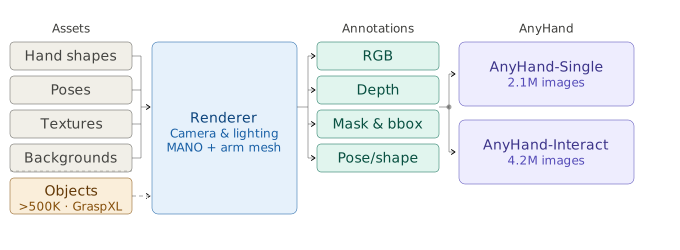
For the implementation and detailed distributions, please see Section 3 and Appendix C of the paper and the project page.
In controlled experiments, AnyHand is added to the training data of existing methods while preserving the baseline architectures and training protocols. Representative PA-MPJPE results (millimeters; lower is better) are:
| Benchmark | Model | Original training | Training with AnyHand |
|---|---|---|---|
| FreiHAND | HaMeR | 6.000 | 5.545 |
| HO-3D v2 | WiLoR | 7.500 | 7.355 |
| HO-Cap (zero-shot) | HaMeR | 4.940 | 4.660 |
The paper also studies RGB-D depth fusion, synthetic-data scaling, and real/synthetic mixing. These numbers are research results for the configurations reported in the paper, not precomputed metrics attached to every published TAR shard. See the paper for full protocols and additional benchmarks.
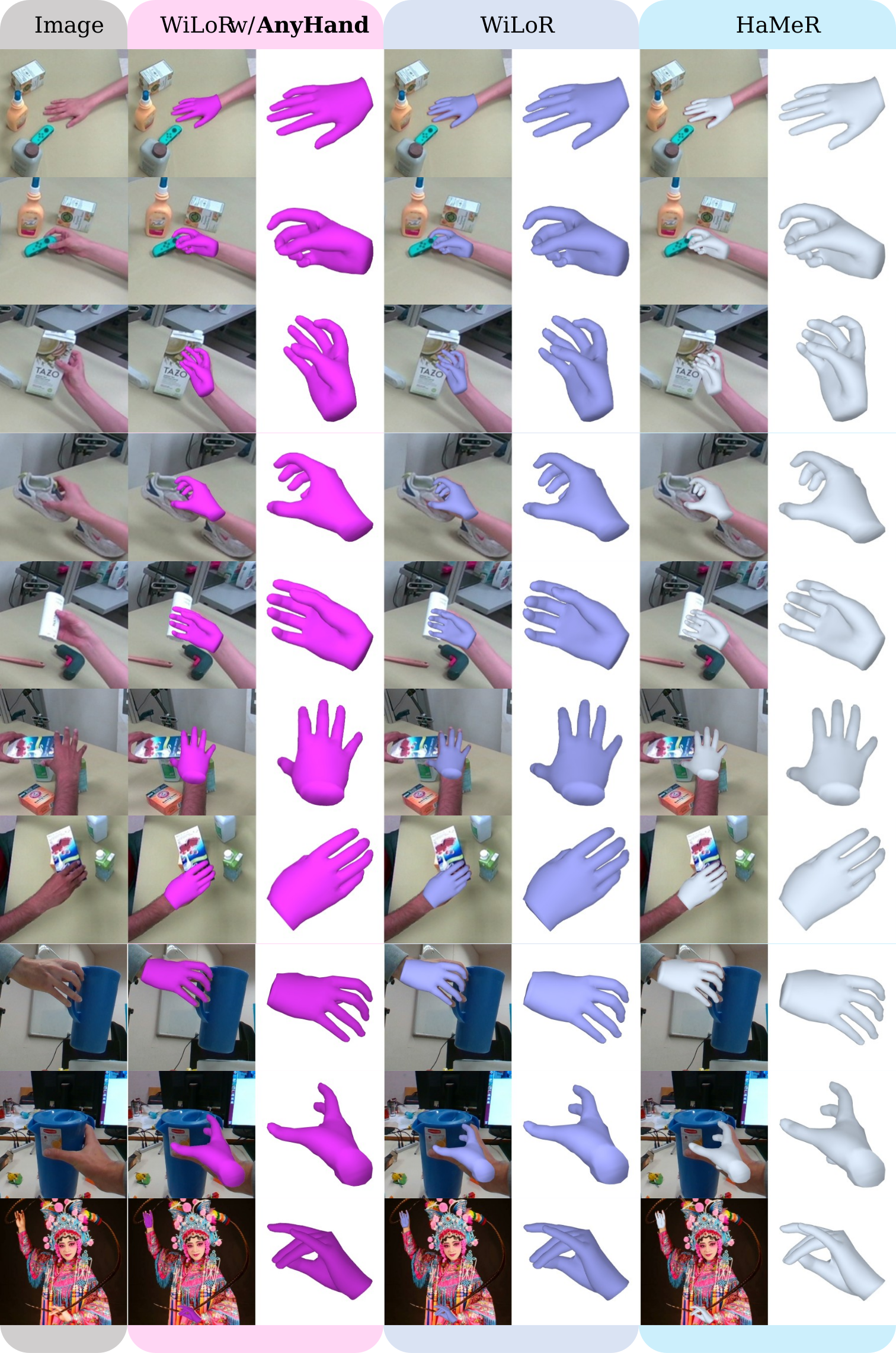
Intended uses: research into 3D hand pose/mesh reconstruction, hand-object interactions, RGB-D supervision, synthetic-to-real generalization, and dataset-scaling or data-mixture strategies. The dataset also supports controlled analysis of appearance, pose, and viewpoint diversity.
Limitations and considerations:
See Appendix F for the limitations described in the publication.
Dataset license: Creative Commons Attribution–NonCommercial–NoDerivatives 4.0 International (CC BY-NC-ND 4.0). This license applies to the dataset release, and should not be confused with the licenses of code, pretrained models, or third-party materials.
If you use AnyHand in your work, please cite the NeurIPS 2026 paper:
@inproceedings{si2026anyhand,
  title     = {{AnyHand}: A Large-Scale Synthetic Dataset for {RGB(-D)} Hand Pose Estimation},
  author    = {Si, Chen and Liu, Yulin and Ai, Bo and Xie, Jianwen and
               Potamias, Rolandos Alexandros and Zheng, Chuanxia and Su, Hao},
  booktitle = {Advances in Neural Information Processing Systems},
  year      = {2026}
}
Links: Project website · Paper · Code · Checkpoints · Interactive demo · Dataset discussions
For questions or release issues, please use the GitHub issue tracker or the Hugging Face dataset discussions.